Strength and Conditioning
Farmington, Michigan 810-201-4857


After the gaining proficiency in the other lifts and acquired some strength, some trainees may elect to learn the power clean or snatch and add it to their program. These movements are strictly optional.
The power clean is unlike the other lifts. It is an explosive movement, which teaches the trainee to develop force rapidly. The other lifts place emphasis on exerting force over a distance, which is mechanical work:
Work = Force x Distance
The power clean emphasizes exerting force over a distance rapidly, minimizing the amount of time for the work. When one does the same amount of work, but in half the time, one doubles power:
Power = Work / Time.
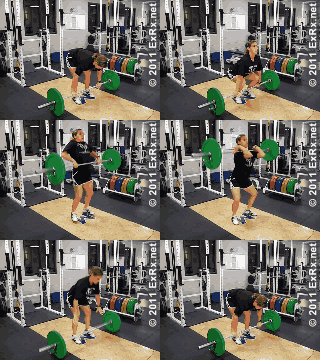
The power clean is, at the most basic level, a deadlift that turns into an explosive jump when the bar reaches the mid-thigh. This jump launches the bar straight up so the lifter can catch the bar on her shoulders.
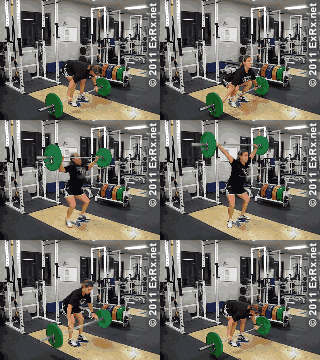
Some people with long forearms or elbow flexibility issues are not able to perform the power clean. These individuals may elect to learn and train the power snatch, a similar movement in which the bar is caught overhead instead of on the shoulders.
The power clean and power snatch are not suitable for some trainees in their 50s, 60s and beyond. Those who can perform these lifts without discomfort are encouraged to train them. Trainees who are unable or unwilling to perform the power lifts may use dynamic effort sets to build power, or they may elect to train only the slow lifts--which is just fine, since building strength naturally increases power, even without training in the explosive lifts. Discussions with the Coach and some experience on the platform will clarify what's right for you. There is no extra charge for learning and training the power movements.